THE MOON IN THE GUTTER ARCHIVES

I AM CURRENTLY WORKING ON EXPANDING AND REVISING SOME OF THE BEST PIECES FROM MOON IN THE GUTTER AT MY OFFICIAL SITE, NOSTALGIA KINKY. THIS NEW PROJECT CAN BE ACCESSED BY CLICKING THE PICTURE BELOW.

THE MOON IN THE GUTTER ARCHIVES

Recent Posts from my Official Site

Showing posts with label Outside Submissions. Show all posts

Saturday, July 4, 2026

Outside Submissions on Jean Rollin: Jeffrey Allen Rydell's "The Transfigured Night, a Trip to the Beach"

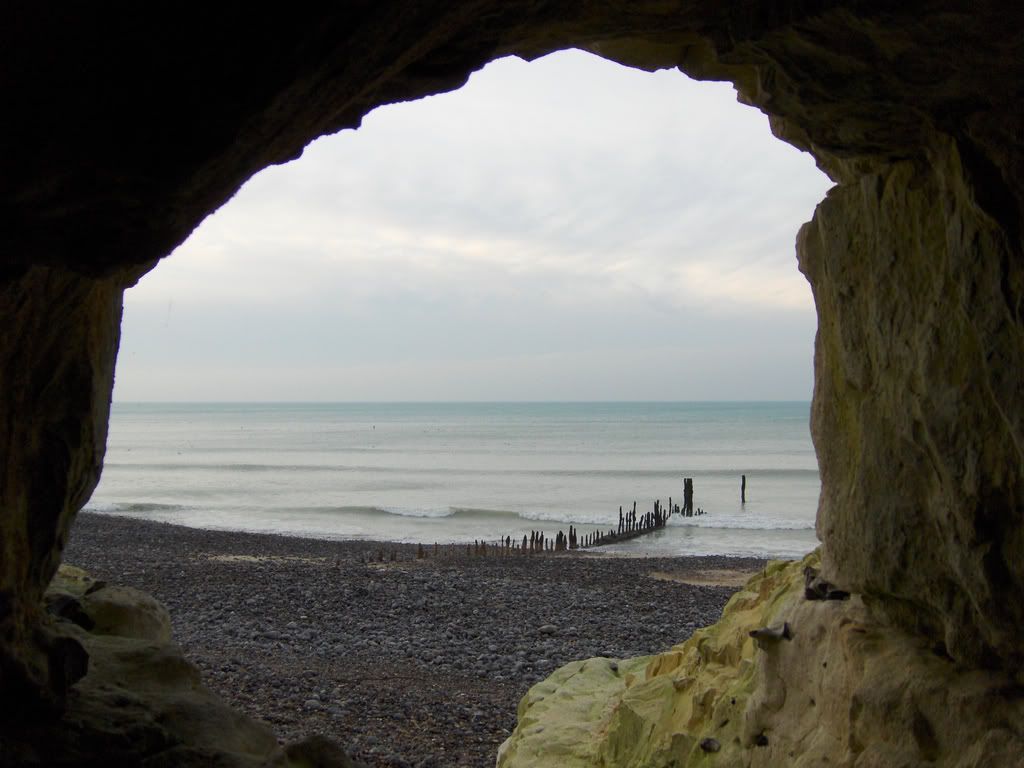
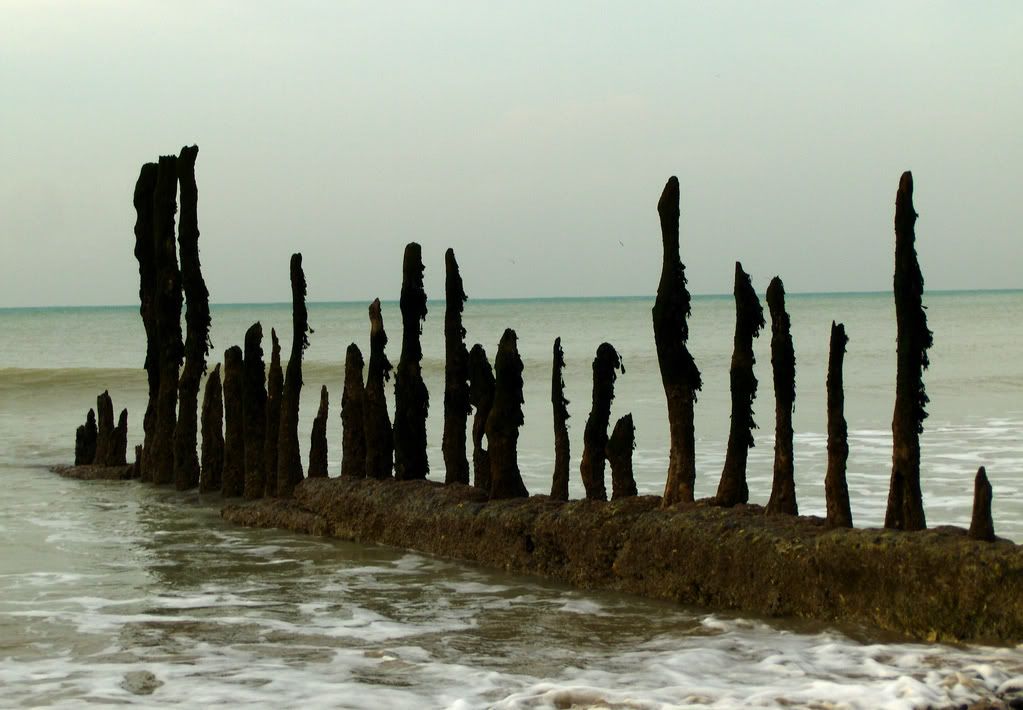
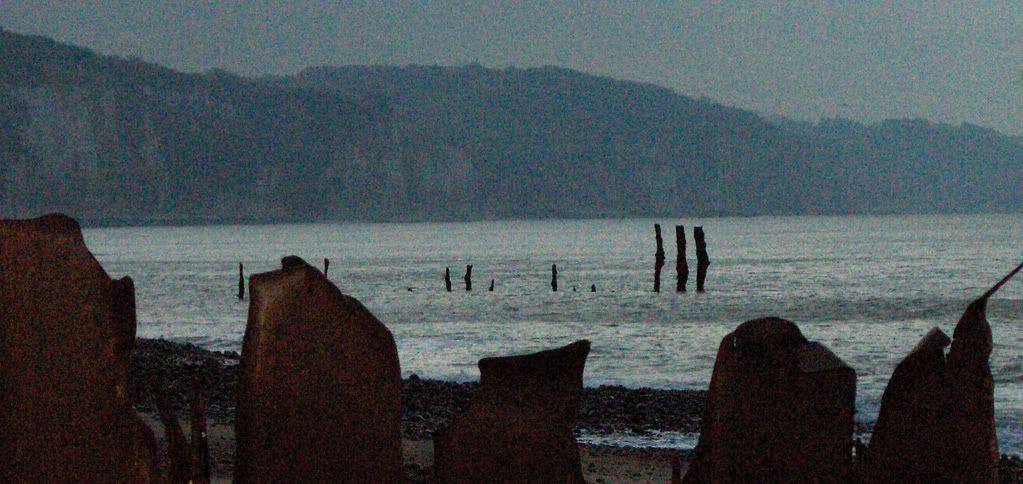
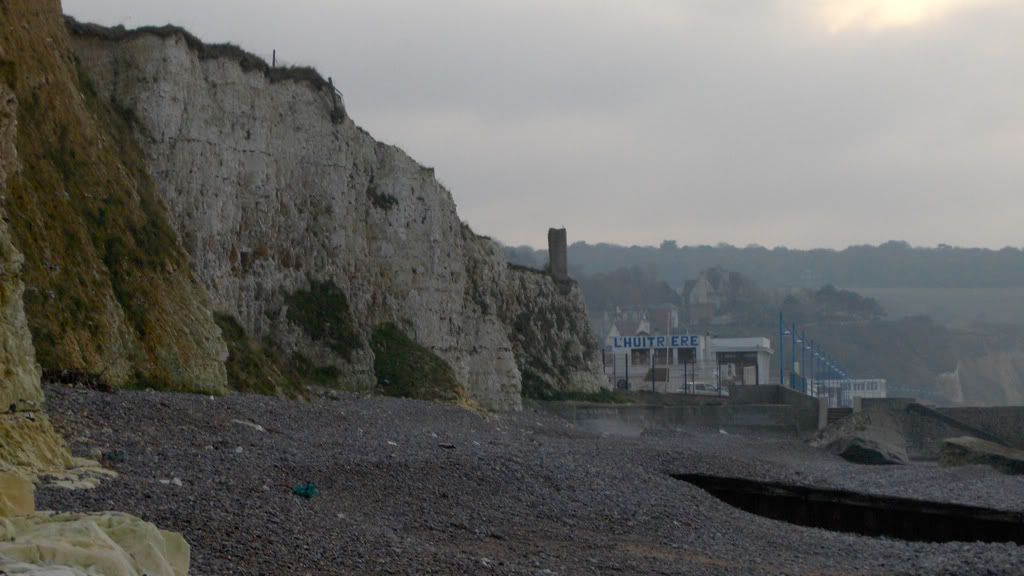
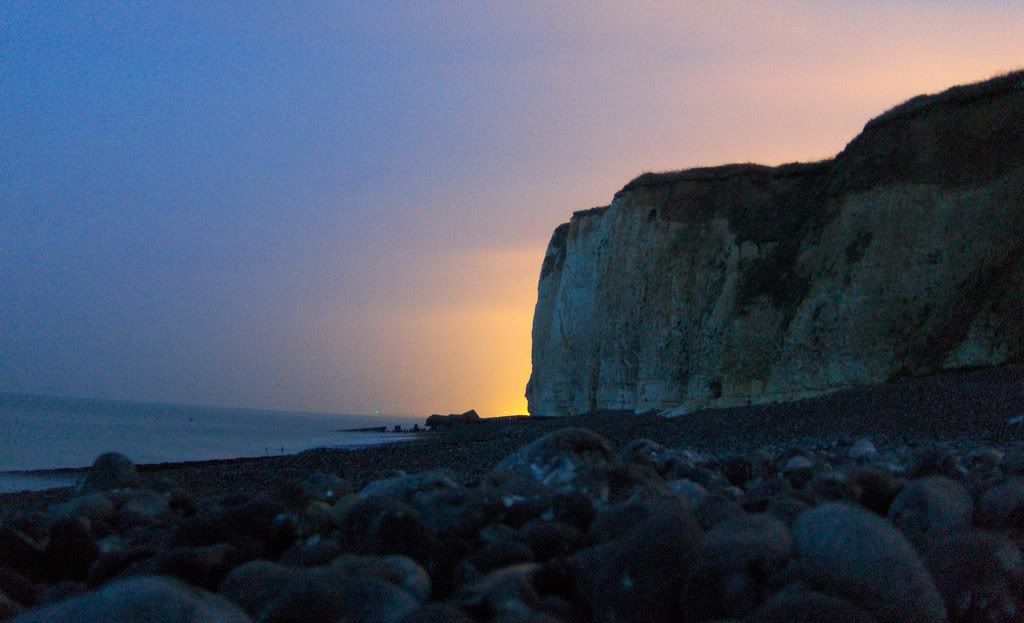
One hope I have for Fascination is that I might get some outside submissions from other Rollin lovers that I can post here. The lovely piece below was emailed to me from Jeffrey Allen Rydell, and he has given me his kind permission to post it here. This can originally be found here at The Mobius Film Forum and the incredible photos Jeffrey took (some of which can be seen below) can be found here at his Photobucket account.
A great big thank you to Jeffrey for allowing me to use this, and I hope it will encourage more fans to email me their thoughts, memories and reviews for possible posting here.


"The Transfigured Night, a Trip to the Beach"

Night Tide

"It’s the end of November and, as the train moves toward Normandy, it grows cold.

I arrive in Dieppe by 2pm and check into the Hotel du Plage, one of many maritime-themed accommodations sprinkled throughout the small fishing village. Backpack tossed to the bed, I head for the sea.


I’m expecting to find the familiar forlorn rows of stakes, the pocked and chalky cliff-face, the churning pull of the surf I know so well, yet have never seen. After unsteadily making my way down the rocky surface of the beach, close to the water as I can get, I realize that this is all wrong. As far as I can see, in either direction, it’s too populated, too maintained, too valued. Even the fact of the castle overlooking the town, while arresting, is wrong. This isn’t the place.

This is not Jean Rollin’s beach.

I double back to the office of tourism I had passed while looking for my hotel. There, I adopt my usual outsider affect: utterly clueless. It isn’t much of a stretch, and I find it helps with the language divide. Also helps to have plenty of things to point at. Unfortunately, I only have the map of Normandy I’ve just taken off the rack on my way in. “A beach near Dieppe”, Rollin said in Immoral Tales. How hard could it be?


The French really don’t know much about this Jean Rollin guy.

The very patient and pretty tourism lady does her best to understand what I’m after, calling superiors to ask if they know what the hell a ‘Rollinade’ is. One vaguely remembers sex-horror films like this, but had no idea any of them had been shot anywhere near here. We narrow it down to a couple of beaches (none of which turn out to be the right one in the end), and I ask for an Internet cafe – I need to re-research this.

There is exactly one place in Dieppe where the beer and bandwidth flows: the Art au Bar Cybercafe. I cold-contact Mark Jason Murray, Webmaster of Virgins & Vampires: The Official Website of Jean Rollin, to plead his assistance, and also print out some screengrabs of Rollin’s beach in hopes that someone will recognize it. The man working the Internet café thinks that it looks like the beach at Quiberville, or perhaps Varengeville …


While waiting for Mark’s reply, I head out to take stock of the town, and to find some dinner. Till now, I’ve stuck to the periphery of Dieppe, bordering the harbor and the oceanside. Now that I descend into the heart of the village, I’m surprised to find a bustling shopping vicinity, which looks just a bit like the back-streets of the Latin Quarter of Paris. There are people everywhere, and though the shops are of little interest to me, they too are plentiful. The young man at the video store (which incidentally, stocks no Rollin) thinks the beach at Pourville is what is pictured in the charcoal-contrasted printouts I show him. No one I ask has heard of Jean Rollin or his films.

I leave the crowds behind and decide to sample one of the scallop-based dishes that are said to be Dieppe’s specialty. There’s certainly no lack of brasseries, so I choose one and set to tucking in.

Upon emerging from the restaurant full and satisfied, I immediately notice the change.

It’s now nearly dark, and the happy throngs of shoppers have vanished. There’s no sign that these shops were even open recently, much less healthily patronized. The only movement on the empty, unlit streets is the slow prowling of a single police cruiser, a searchlight to the side seeking out signs of unwelcome activity. It’s all of 7pm.


I make my way back to the Internet hub, suddenly unconfident that it will be open. The cruiser paces me for a block, and concluding I present no threat, turns down a dim alley and disappears. Now there is nothing moving on the street but me. It’s become quite cold. I wouldn’t be at all surprised to see two blonde twins, draped in diaphanous flows of color, appear out of the gloom and drift toward me. Maybe there’s a curfew in place to ward off just such encounters…

I reach the “Art au Bar” regrettably unmolested. It’s surprisingly still open, though empty save for the attendant. I am warned upon entering they are to close at 8. Film Fanaddict Mark has emailed me back with the answer, gleaned from an interview featurette on the recent French DVD of Lips of Blood: Pourville - an even smaller town further down the coast. A follow-up search reveals that Rollin is neither the first nor the most famous admirer of this stretch of beach. Claude Monet was very fond of the cliffs here and painted them often.


I know what I must do. In the late afternoon, I will be on the beach at Pourville as night falls all around me…"

by Jeffrey Allen Rydell, 2007.

Wednesday, October 10, 2012

A Jean Rollin Top-Ten List by Jérôme Peyrel

I am very pleased this morning to present another Jean Rollin Top-Ten list from a reader here at Fascination.  This one comes from French writer Jérôme Peyrel.  Thanks very much to Jérôme for putting this together and for offering an English translation for my readers here.
 
1) the perseverance.
I love that Jean Rollin followed through his career, his films, his books ; the figures he created, the mixture he worked on, the way he told, over and over, the same story.
2) that poetic shot, in Lèvres de Sang, in which Frédéric can't catch the woman he dreams of since his childhood, in the cemetary... The light tears them apart, even if they are so close...
3) the Encore collection. Remarquable edition for these movies.
4) the Castel twins, that haunt my dreams, as they haunt La Vampire Nue.
5) His poetry of pause : the cinema of Jean Rollin is made of still pictures, beautiful, intriguing, they carries the essence of his conception of horror, surrealistic and free.
6) the 30 minutes of Le Viol du Vampire, and the camera that goes round and round the characters ad mauseam. I deeply love the duel.
7) The Philippe Druillet posters, in particular the one for La Vampire Nue.
8) The book Les Demoiselles de l'Etrange, that made me discover Erik Satie... (there's a lot of artists I discovered through Jean Rollin, notably Clovis Trouille).
9) La Rose de Fer, the Limoges screening in the late 90s. The film didn't arrived, so they decided to run the VHS ! Anyway, everybody was happy, and that day, we briefly talked about the movie with Jean Rollin. I looked forward to read the short story La Nuit du Cimetière (that can be found in the revue L'impossible number 11), during years since that day.
10) His critic works for french anarchists magazines in the 60's. One of his hidden sides.

Sunday, October 7, 2012

A Jean Rollin Top-Ten by Robert Savage


Here's another entry in my newest giveaway here at Fascination.  Thanks so much to Robert Savage for compiling his personal Rollin list and I hope he enjoys the poster!  I still have one more prize left so start compiling your own Jean Rollin top-ten and email it my way. 

1. Shiver Of The Vampires because a strange naked lady comes out of a grandfather clock.

2. The Iron Rose because it's really unlike any other film ever made. It's not even like any other Rollin film ever made. Clown in cemetery. Slow moving. Makes me feel like I'm having one of those foggy dream like hangovers.

3. Immoral Tales book. Great book on Euro Horror in general with a nice big section dedicated to Rollin. My introduction.

4. Saga De Xam graphic novel. Incredibly cool large hardcover comic written by Rollin and illustrated beautifully by someone called Nicolas Devil. I don't understand a word of French but I can stare at this book for hours. I wish somebody would translate this into English. Very rare and one of my prized possessions. Did Nicolas Devil ever do anything else?

5. Living Dead Girl because it's a great bloody mess and a great bloody story.

6. Virgins and Vampires book. Nice companion to Rollin's films. It's not a huge book but it is a great go to guide if you want to read up on any of the films. Plus it has some good photos.

7. Finders Keepers soundtrack albums. I'm so glad that someone is releasing all of this great music and doing it so well. Great liner notes and sound quality.

8. Water. Rollin liked to shoot by the water and I like to be by the water.

9. Kino blu ray releases. I like the old bootleg quality stuff too because there's a certain charm in watching some bad quality vhs and thinking you're hip to something the rest of the world is unaware of, but it's really great to see these in a new and more clear light. But I'm hanging on to my old bootlegs.

10. Lesbian Vampires because they're lesbians and they're vampires.

Thanks again Robert!

Saturday, October 6, 2012

A Jean Rollin Top-Ten List by Daniel Orion Davis


A great big congratulations to Spellbound Cinema's Daniel Orion Davis for being the second entry in my Jean Rollin Personal Top-Ten giveaway!  Daniel really knocked it out of the park with his list and I know all fellow Rollin fans will find this detailed post a wonderful example as to just how much Rollin means to his most dedicated fans.  Thanks so much to Daniel for this wonderful piece and I hope you enjoy your prize.  Keep those lists coming!


1) The Bond of Sisters

With the exception of the beach at Dieppe (see entry #2), there is no
image more frequently returned to than that of a pair of young girls.
Obviously, the Castel Twins are the most memorable embodiment of this
archetype in Rollin's work, but the characters reappear far more
frequently than he was able to with with Marie-Pierre and Catherine.
Lost in New York, Fascination, Living Dead Girl, The Demoniacs and (of
course) Two Orphan Vampires all feature this dynamic without the
participation of a Castel. Whether the girls experience together an
adventure or a shared tragedy, it is clear that Rollin believes they
are empowered by their relationship to each other. Arguably the most
moving tragedy in Rollin's oeuvre results from the separation of such
a pair; both the narrative and the emotional resonance of Living Dead
Girl
revolve around the disruption of a childhood bond and the girls
are never truly Lost in New York until they are separated from each
other.

2) The Romance of Travel

No Rollin fan can doubt that a boyhood trip to Dieppe had a profound
effect on young Jean's thinking. Here at once was a new stage on
which his fantasies would be set for the rest of his life. Not only
did this create a life-long love affair with the beach at Dieppe, but
it seemed to impress upon Rollin the belief that travel was an
inherently romantic pursuit, filled with opportunities for adventure
and transformation. From one of his earliest shorts, Les Pays Loin,
in which the peculiarities of unfamiliar language and geography seem
to cause the protagonists to doubt their own identity and history, to
later films like Lost in New York and Sidewalks of Bangkok (in which
Rollin's romantic visions of these foreign cities define the
narrative) travel, in the Rollinade, is an opportunity for an
experience that is simultaneously more authentic and more fantastic.

3) The Importance of Memory

One of the most tragic things you can experience in a Rollin narrative
is the loss of your memory -- whether that be the memory of your
personal history or your connection to a shared cultural history.
Without memory, we are automatons, mere consumers. Memory allows us
to attribute meaning, make connections and bond with others. In Night
of the Hunted
, even a fabricated memory can have the power to restore
some value to an otherwise meaningless existence, while in The Living
Dead Girl
memories restore the humanity to the title character who is
otherwise just a void, a gnawing hunger.

4) The Seductive Power of Death

For many, death and its iconography are something to be shunned, as
though we can apply the childhood logic that if we don't see it, it
won't see us. But Rollin sees through such delusion and recognizes a
primal beauty to the ways in which we have visualized and portrayed
our own mortality. This is why his films are so frequently labeled as
horror films, despite having none of the narrative trademarks of the
genre -- visions of decay and morbidity haunt his films from first to
last. The Iron Rose, perhaps his greatest achievement, makes explicit
this dynamic as it considers two very different reactions to being
trapped in a cemetery, the literal land of the dead. Both parties end
up facing the same fate, but only "the girl," who has seen the beauty
in death, is transformed by it and thus transcends it.

5) The Passing of the Old World

Of all the filmmakers you could compare Rollin to, perhaps Jacques
Tati is an unusual choice. But it has always seemed to me that they
share a particular obsession: a deep sadness at the passing of the old
world and its replacement with a sterile modernity. Consider Playtime
and Night of the Hunted as strange companion pieces. Both are defined
by their being set among the glass and steel of modern office
buildings. Both seem to believe that such an environment can only
dehumanize its inhabitants. But between the two directors, Rollin was
far less optimistic. Whereas Tati seemed to ultimately suggest that
human nature would eventually assert itself against modernity and
carve new, more organic spaces for itself, anyone who has seen the
denouement of Night of the Hunted knows that Rollin believed that
something precious was being lost, perhaps irrevocably. Like the
scientific cult in The Nude Vampire, our age's attempts to measure,
rationalize and control our world must inevitably lead to our (or its)
destruction.

6) The Inadequacy of Language

Rollin's characters, especially in his later films, love to talk.
They circle around their subjects with a piling up of poetry, an
accumulation of words. Yet perversely, for all the beauty in the
language, Rollin seems intensely skeptical of our ability to actually
communicate with each other, to use language as a vehicle for sharing
our experiences. Perhaps its language's connection to rationality,
but speech frequently seems inadequate for its purpose in the cinema
of Rollin. Characters struggle against language as an implacable
barrier as they try to make each other understand the ineffable. His
filmography is nearly bookended with meditations on the subject. In
Les Pays Loin the protagonists wander in a labyrinth created by a
language barrier. In The Night of the Clocks, everyone has something
to say to Ovide, but their words seem only to draw her further and
further away from an understanding of her cousin (an understanding
that only images, icons, and experiences can really provide.)

7) The Redemptive Power of Fantasy

Just as we are made less human when we can no longer remember, we can
transcend our limitations when we are able to indulge our fantasies to
their fullest. Rollin spent his career chasing the fantasy figures
that made such an impression on his youth, a pursuit that enriched not
only his life, but the lives of all those who loved his films. His
characters, in turn, joined in on this pursuit whether by adopting
costumes (The Nude Vampire, Requiem for a Vampire), engaging in
performance (Shiver of the Vampire, Mask of Medusa) or simply -- and
perhaps most perfectly -- by telling each other stories (Lost in New
York.)


8) The Strength of Femininity

The heroic figures in Rollin's cinema are women. Even when the
protagonists are male, they are defined by their relationships to
women. Frédéric, in Lips of Blood, may be the single most appealing
and sympathetic male character in all of Rollin's filmography, but his
story is the story of a woman. His life is defined by his encounter
with a woman more captivating and powerful than he could ever hope to
be. Of course, the best illustration of the gender dynamics in
Rollin's work is in Fascination. There Marc, the robber who betrayed
his friends, clings to the symbols of male strength: his gun, his
will, his sexual dominance. Yet from the moment he encounters
Elisabeth and Eva he is at their mercy, whether he realizes it or not.

9) The Priority of Eroticism over Sex

One of the most common things you will read about Jean Rollin is also,
I believe, one of the most wrong. I don't know how many times I've
read critics, professional and amateur, asserting that Rollin was
obsessed with sex (usually given as somehow being proof of his
inadequacies as a director). This has always seemed to me to be the
most facile of observations. Yes, his films are replete with nudity
and with sex. But there are two considerations here. First, anyone
serious about understanding Rollin's work needs to take into account
the demands of the production environment in which Rollin worked.
Rollin frequently had to promise a certain amount of sex to get
funding for his films, and often (as in the case of Night of the
Hunted
) faced a continual struggle to retain his vision against
producers who would be more satisfied with a simple porn loop. No,
the sex scenes in Rollin's work are frequently perfunctory and rarely
possess the magic of his best moments. Second, is narrative context.
Rather than the sex act, I think it is eroticism that fascinated him
-- the aesthetics of desire. Just as the vampires that run rampant
through his films are defined by their hunger, sex in a Rollin film is
best when it's a desire unfulfilled. Many of the most striking images
in his filmography are deeply erotic but removed from an explicitly
sexual context: the iconic image of Brigitte Lahaie barely robed as
she wields a scythe in Fascination, Sandra Julien emerging from the
clock in Shiver of the Vampires, Françoise Pascal transformed by her
experience on the beach at Dieppe in The Iron Rose. In all three
cases conventional sexual dynamics and relationships are an obstacle
that has to be overcome before the true eroticism emerges.

10) The Value of Collaboration

For all that this list has focused on the man himself as the driving
force behind his films, the final theme I want to highlight is the
beauty and power that comes from collaboration with like-minded
friends. Rollin had an eye for beauty and a powerful imagination, but
his films would not have been the impressive body of work without the
host of tremendous talents he surrounded himself: the Castel twins,
Brigitte Lahaie, Philippe d'Aram, Jean-Jacques Renon, Willy Braque,
Natalie Perrey -- these are just some of the many frequent
collaborators who brought out the best in Rollin and did their best
work at his direction. In the 1980's financial problems drove Rollin
to prose rather than cinema as the outlet for his creative energies.
Undoubtedly the lack of constraints freed his imagination in a way
that it never had been before. Yet despite his success in this
endeavor he returned to film, even facing new limitations he continued
to make films right up to his final years. Why? Surely part of the
reason was the pleasure of working with others, seeing his imagination
reflected and transformed by the ideas of his companions. Why else
make a film like Night of the Clocks which, in addition to being a
meditation on his own mortality, was a joyful tribute to all the
people he'd worked with and the ways in which they continued to haunt
his imagination -- and ours.

Thanks again Daniel!

Monday, June 4, 2012

Lilies & Remains: My Tribute to Jean Rollin (A Guest-Post by Heather Drain)

***Simply put, Heather Drain is one of my favorite writers on the planet so I am quite blown away this morning to present this amazing piece she has written in tribute to our man Jean Rollin. Heather's always intelligent and eloquent writing has appeared in the pages of Video Watchdog, Screem, Ultra Violent and many other publications. She also has her own fascinating blog, Mondo Heather, and posts regularly at Cinema Head Cheese as well. I can't thank Heather enough for submitting this haunting and lovely piece on Jean Rollin and I am honored to present it here. Enjoy and comments are most certainly appreciated.***


Few suffer in this world like the misunderstood. Poets, monsters, dreamers, madmen and artists alike have to battle the often inherent ignorance of human nature. A filmmaker like Jean Rollin, for example, was a man and an artist who dealt with the slings and arrows of an often unappreciative world. He was most certainly a poet, for so many of his films possessed a melancholy and heartfelt poetry to them. (With “Lips of Blood” and “Living Dead Girl” sticking out to me the most, but they are far from the only ones.) Rollin was a not a madman, but he was a dreamer, though the twain have been known to meet and he painted his visions with monsters, most famously, vampires.

Part of the appeal of a filmmaker like Jean Rollin was that his approach was never simple. Traditional horror can be a genre fueled by very basic morals. Black and white, good versus evil, the whole nine yards. Horror, dating back hundreds of years, has been a device to both give us a shiver of adrenaline but also a safety method of coping with the inevitable darkness of this world. With Rollin, the darkness was a different type of shadow. There are rarely clear cut villains or villainesses, for even the monsters have hearts and souls, caged by their own curse. Unlike so many monsters, Rollin's are usually beautiful, in spite of the air of death that clamors all around them.

On top of all that, Rollin utilized imagery that we usually associate with “classic horror cinema.” Items such as bats and castles perennially pop up, but are weaved seamlessly into the dream world of mist, ghosts, gauze and decadent-gorgeous-sad-eyed undead. In essence, he did what any wholly brilliant filmmaker does, which is putting his thumbprint on his art. No matter that there have been umpteen horror movies with blood drinking beauties, because Rollin's films look and feel like nothing else. Forty plus years and the freshness of his vision has not even a speck of dust on it.


The thing that haunts me the most about Jean Rollin, other than how ethereal, sad and full of beauty his films are, is how gypped he really was. It's an age-old quagmire. How many painters and writers lived lives full of pain, poverty and semi-obscurity while creating on this plane, only to be championed after their bodies have long merged with the Earth? Too many. Van Gogh wasn't the exception, he was the norm. Filmmakers are no different, though at least with Rollin, a steady cult started growing while he was still with us, so he got to leave knowing that there were more and more fans that truly loved and appreciated his films.


That said, it all feels like so little. Maybe part of it was that France, historically, has never been a huge magnet for homegrown horror cinema. There are notable exceptions, like Franju's masterful “Eyes Without a Face,” but compared to the United Kingdom, Germany, Mexico and America, it is fairly low on the genre film output. On top of that, no matter what country you live in, horror was and, in many ways, still is considered a notch above pornography and a couple of notches below everything else. (Proof? Note how many A-list directors and actors will refer to films that are clearly horror themed as “thrillers,” practically tripping over themselves to skirt away from the lurid “H” word.)

With a director as unabashedly in love with all things dark and fantastic as Rollin, not to mention one that often incorporated elements of eroticism, he was critically doomed from the get go. Why horror and sex, two fundamental aspects of our species, were and are the red-headed stepchildren of film, is a mystery usually mired in double-standards, puritan-hangovers and smatterings of classism. (And speaking as a red-headed stepchild, I know where I speak from.) After all, war is one of the biggest and most tangible horrors for many on this planet and it is considered a respectable topic for film. But use a mythical device, a la vampires and revenants, and forget about it. Sure, there are horror films that use exploitative elements, but there are equal amounts of dramas that are inherently just as emotionally exploitative. (Exhibit A: “Terms of Endearment.”) The true future of art needs to be vital and with all limitations, antiquated notions and categories sheared to ribbons. Rollin is a godfather of this because he took what he needed from his cinematic and literary heirs and used it to create something new.


His dreamy world haunts not just from fear abut from the ghosts of our own human condition and dark planet. Jean Rollin is a filmmaker whose creative impulse was pure and beautiful, even when it was ugly. As his films are becoming more and more preserved and available, the stronger and more pronounced his legacy grows.

Copyright 2012 Heather Drain

...

Monday, May 21, 2012

Ben Haggar from Breakfast in the Ruins on The Escapees (A Guest-Post)

One of my absolute favorite spots on the net is the incredible Breakfast in the Ruins, a film blog run by a really terrific writer named Ben Haggar. I was really excited recently to hear that Ben was going to contribute a guest-post for Fascination and today I am thrilled to present it! So here is Ben's excellent new look at one of Rollin's less-discussed films, the very intriguing Les Paumees Du Petit Matin (The Escapees). Thanks so much to Ben for contributing this very fine piece and I hope everyone will head over to Breakfast in the Ruins after reading!


With the renewed interest in Jean Rollin’s work that has followed in the wake of Kino/Redemption’s reissue campaign and FindersKeepers soundtrack releases, now seems as good a time as any to lavish some attention on what I’d consider to be perhaps the most overlooked item in his catalogue, 1981’s Les Eschappees, aka The Runaways, aka The Escapees.

Long written off as a minor film, ‘The Escapees’ remained largely unseen for many years, only seeing release on Region 2 DVD from Redemption in 2008, seemingly after they’d long cleared their vault of everything else Rollin-related. Even Tohill &Tombs, in their landmark study of Rollin’s work in ‘Immoral Tales’, seem lukewarm on the film, praising the opening and closing scenes and the way the relationship between the central characters is developed, but largely writing it off as a ‘failed thriller’, concentrating on the problems Rollin encountered with proposed co-writer Jacque Ralf, and noting that the film ‘drags woefully’ (Immoral Tales, p.160).

Perhaps this general lack of availability and critical enthusiasm – together with the lack of fantastical or exploitation elements – has tended to make the film a bit of a hard sell for casual fans. Despite all this, I would still consider ‘The Escapees’ to be an essential Rollin film. Though as flawed and idiosyncratic as anything else he lent his name to during the ‘80s, it is still a singularly personal piece of work, invoking all of his key concerns as both a director and a human being, and gaining a particular poignancy through its investigation of what happens when the fantastical world he created in his ‘70s horror films makes the painful transition to the drab and impoverished reality of marginal French life in which those films were actually produced.


It’s certainly hard to imagine a more quintessentially ‘Rollin-esque’ opening to a story than the one found here, as two troubled girls (Laurence Dubas and Christiane Coppé) make their escape from the stifling confines of a particularly oppressive psychiatric institution, united in their search for … who knows what? Adventure, beauty, companionship? Above all, the mysteries of ‘the real world’, of which they know little, despite extrovert Michelle’s claims to the contrary. With a little tweaking, we could almost be watching an unfilmed prequel to ‘Requiem for a Vampire’, but rather than entering a fairytale world of chateaus and vampires, Michelle and Marie now find themselves lost in altogether more mundane circumstances.

Recalling the bleak visual sensibility of the previous year’s ‘Night of the Hunted’, Rollin’s camera captures suburban France at its most dismal and overcast, as the girls undertake their journey through freezing dockyards, rainsodden woods and motorway scrubland. Colour only enters proceedings when they stumble upon Maurice’s travelling show - a threadbare troupe consisting of a couple of exotic dancers and a faded fairground stage-set, who set up for business in a car graveyard near an unnamed port town, performing to a weather-beaten audience of workers, sailors and transients.

The poverty-stricken sadness of Maurice’s show and its patrons is beautifully evoked (presumably because the production itself was pretty poverty-stricken), with the dancers performing to tacky canned music, just in front of the train tracks, where anonymous carriages roll on into the night. Conjuring the most forlorn kind of faded funfair seediness, the scene puts me in mind of the Graham Greene quote immortalised by the Mounds & Circles weblog: “Seediness has a very deep appeal; it seems to satisfy, temporarily, the sense of nostalgia for something lost”.


Although functioning as a simple and affecting tale in its own right, ‘The Escapees’ can on another level be read partly as a extended metaphor for its director’s struggle to realise his more outré visions amid the crushing banality of the world outside his head – an interpretation that the film at times seems to explicitly acknowledge. Certainly, the monologue Maurice delivers to the two girls in defence of his show could scarcely be any more on the nose when it comes to drawing a self-reflexive parallel between the plight of the film’s characters and the way that Rollin viewed himself and his collaborators in the ghetto of porno/horror filmmaking;

“Everyone here is an artiste. A true artiste. And what you see here is theatre. The theatre of the street. The original, the most beautiful. […] Look at my fairground stall, the sailors arguing… it is the great mystery of the fairground show.”

Although impossibly hackneyed by conventional standards (despite the increased realism, Rollin’s gift for naively stilted, unnatural dialogue scenes has not deserted him), the wider resonance of Maurice’s monologue, his exultation of a grand mystery within what any ‘respectable’ citizen would deem a squalid, tacky and dangerous situation, is moving indeed.

There is a certain warmth and romanticism to the way in which Rollin presents Maurice’s show that echoes through the whole film. The drunken crowd remains polite and respectful (for the most part), and a jovial, inclusive atmosphere reigns, even as sexual favours are bought and sold, and as the men invade the stage and lift the dancers above their heads in celebration. The party atmosphere only dissipates when the police arrive, and the crowd abruptly vanishes into the night.

Throughout its run-time, ‘The Escapees’ seems to evoke nostalgia for a kind of human warmth that has been lost from the modern world of wealth and respectability; a warmth that can now be found only amongst misfits and petty criminals, in places where progress fears to tread. Thinking back, this is a theme that can perhaps be traced throughout Rollin’s work, in the comfort his characters seem to find in the old, the derelict, the abandoned – only now the chateaus and cemeteries have been replaced by the community spirit found at Maurice’s show and, later, in Louise Dhour’s docklands bar.


The scenes in Louise’s bar struggle with that particular brand of awkwardness that often afflicts inter-character scenes in Rollin movies, but here too, it’s a convincing sense of warmth and belonging that shines through, anchored by a superb performance from Dhour herself as the matriarchal proprietor, drawing her small ‘family’ of damaged runaways around her as she reads the tarot and imparts advice, sharing an implicit understanding that they all basically share the same history, the same dreams. (A formidable vocalist, her rousing performance of the nautical ballad ‘La Mauvaise Priere’ is a real highlight too.)

It’s perhaps not the most original scenario ever conceived, but again, the simple empathy of Rollin’s approach to his characters gives it a comforting power that’s hard to deny. Until the quartet of decadent rich folk enter proceedings at the film’s conclusion in fact, it’s notable that ‘The Escapees’ is a drama in which the on screen action consists almost entirely of people being kind to each other, as the girls receive unquestioned courtesy and generosity from almost everyone they encounter. The film’s only real antagonists are poverty, social inequality, the law, and the unfortunate constraints of reality itself.


Like all of Rollin’s films, ‘The Escapees’ is an unapologetically sentimental work, thrown together in what can often seem an inexcusably slapdash and fragmentary manner. The earthbound setting perhaps draws undue attention to these perceived imperfections, and the film’s drifting pace, unconcerned with narrative urgency, may prove a bit of a stumbling block for some viewers, just as newcomers to the director’s work might find it hard to deal with the way the characters suddenly lapse into poetic reverie at every opportunity, giving voice to their dreams and fears into stilted, quasi-symbolist fashion.

That the film never even secured a release when it was initially completed is hardly surprising in the face of such wilful eccentricity, but now that we have the privilege of viewing Rollin’s films at our leisure, it would take a hard heart indeed to sneer as Michelle flicks through a picture book, telling Marie of shells shining on the ocean floor and pirates with their cutlasses, or as their friend Sophie announces that her forthcoming journey will take her far away, to unknown adventures. Like the ‘outsider’ and neo-primitive artists Rollin admired so much, his blunt manner of communicating his characters’ inner feelings bypasses the cynicism of any receptive viewer. As fans, we allow him to get away with bungling and pretension that would have us guffawing at the work of any other filmmaker – we can implicitly understand the honesty and depth of feeling he has invested in his characters, and the wider meaning of their plight, and we have no choice but to drop our critical guard accordingly.


Whilst Rollin is often written off as a ‘naive’ filmmaker though (even using the word in a positive context himself in describing films like ‘Requiem..’), his perceived amateurism shouldn’t obscure the fact that much of his technique is still extremely effective. In particular, the experience gained through nearly fifteen years worth of zero budget, shot-on-location filmmaking (has ANY Jean Rollin film ever boasted enough money for a purpose-built set?) had by this stage given him an incredible gift for capturing the emotional resonance of his locations – a skill which is utilised more clearly than ever on ‘The Escapees’.

Seemingly shot over a series of bleak and freezing dawns, the early morning scenes set in and around the docks have an incredibly evocative, sleepless feel to them - a girl slipping out of nightclub door hugging a leather jacket around her, rusty machinery, broken milk bottles and sailors lounging on the wharf watching cargo containers being lifted aboard ship. Whilst the film strives to keep the location fairly anonymous, these images effortlessly capture the transient world of every industrialised port city, from Hamburg to Yokohama, and the way Rollin is able to pull such deep associations from pretty much nothing at all helps highlight his strange, instinctive genius as a director, the surroundings in his films speaking to us as eloquently as his characters’ more direct flights of fancy.


As in ‘Night of the Hunted’, the sudden lurch into sex/violence footage that takes place in the final ten minutes of ‘The Escapees’ is strange and deeply uncomfortable, and, as is often the case in Rollin’s films, the motivation behind its inclusion is uncertain. Was he obliged to insert some salacious material into what would otherwise be a terminally un-commercial film, or was he just including it out of habit by this stage in his career? Or, more interestingly, was he shifting the tone for deliberate effect, to shock and repulse us just when we’d settled into the groove of a modest, heart-warming little film? Despite their tawdry explicitness (instantly upsetting the balance of what would otherwise be the one Rollin film you’d perhaps be able to sell your uptight world cinema fan friends on), the scenes featuring Brigitte Lahaie and Jean Philippe Delamarre as one half of a pair of duplicitous bourgeois couples who trick the girls into accompanying them home are still horribly effective in their own way. By this stage, our identification with Michelle and Marie is so strong that the very thought that they might not make it to the ship that awaits them at the harbour at 4am is unthinkable… and the fact that their fantastical voyage is halted by an invasion of sleaze and gore of course adds a further tragic resonance to the self-reflexive message Rollin seems to be trying to convey in this film.


The struggle between romanticism and realism in Rollin’s later films is nowhere more apparent than in the desperate need we feel for these girls to embark on their journey. Of course stowing away on a naval vessel bound for parts unknown is by any yardstick a pretty bad idea for a pair of young women, but from their own naïve point of view, it is the only possible course of action: to keep moving, to always be ‘elsewhere’, to try anything to escape their dismal surroundings. As Michelle says at the start of the film, “It doesn’t matter where. Elsewhere. There are always elsewheres everywhere.”

At first I thought ‘The Escapees’ and ‘The Runaways’ were pretty bland, utilitarian titles for this movie, but the more I think about them, the more perfect they seem. Michelle and Marie aren’t simply ‘escapees’ from the institution at the outset - their entire lives are focused on escape – from loneliness, from social norms, and from the confines of reality itself.

In one sense, their escape attempt proves futile, as venality and lust leave them more trapped than ever. On the other hand though, isn’t it a *direct* way out of the cold world around them that they’ve been seeking all along? By rolling out the ol’ ‘Bonnie & Clyde’ ending, isn’t Rollin essentially echoing the unsettling final message of many of his best films (Iron Rose, Lips of Blood, to name but a few), encouraging his characters to welcome death with open arms, as an opportunity to step beyond earthly banalities and embrace a kind of eternal mystery..? What are his films after all, if not a celebration of mystery, and what greater mystery can there be than that which lies beyond the veil?

Tuesday, May 15, 2012

Only the Cinema's Ed Howard on Lips of Blood (A Guest-Post)

***Today I am very pleased to present this guest-post from Ed Howard, one of the best writers on film and music around. Ed runs the terrific Only the Cinema, a blog that features some of the most incredibly absorbing and intelligent writing on film imaginable. I have followed Ed's work at Only the Cinema since he started it back in 2007 and his work is always extremely inspiring. I was thrilled recently when Ed wrote his first piece on one of Jean Rollin's films and I am grateful that he is sharing his new look at Lips of Blood here today! For more information on Ed, please visit his terrific Only the Cinema and comments, of course, are always welcome here. Thanks to Ed for doing this and I hope other writers who admire the cinema of Jean Rollin might consider offering up a guest-post as well!***


Jean Rollin's best films use B-movie horror plots and low-budget production values as portholes into an eerie, unsettling dream world that ultimately has little to do with typical blood-and-gore horror movies. This is especially true of Lips of Blood, one of the director's finest works, and one of his most dreamlike and abstract. The film is a slow, sensuous study of the power of memory and the lure of childhood fantasies, a feverish dream of a film that chronicles a quest that's as much mental as physical.


Frederic (Jean-Loup Philippe) is at a party when he sees a photograph of a ruined castle that triggers a previously suppressed childhood memory or dream. He comes to believe that he's been to this castle as a boy, and that he's forgotten it for some reason; his childhood is a blur to him, and he's long felt disconnected from the stories that his mother (Natalie Perrey) has told him about his forgotten boyhood. The photograph instantly opens a path into his memories, stirring up images of a dreamlike night that he spent in the castle, watched over by a beautiful young girl (Annie Belle) dressed in white. He'd repressed the memories of the castle and the girl, but now that they've entered his mind again, he becomes obsessed, fixated on discovering the castle's whereabouts and trying to locate the girl.


Frederic is haunted by this dreamlike memory, and the film is all about the power that this fixation has over him. At the party at the beginning of the film, he compliments a girl on her perfume, prompting her to pointedly respond, "scents are like memories; the person evaporates but the memory remains." In Frederic's case, the memory too had evaporated for twenty years, but now it's wafted back up into his senses, and he begins seeing the mysterious girl from the castle everywhere. He goes to see a movie — the poster outside is for Rollin's The Nude Vampire, but the theater's actually showing The Shiver of the Vampires, suggesting how intimately connected all these gothic vampire fantasies are — and the girl appears in the theater, beckoning him to follow her. She leads him to a crypt, where Frederic unwittingly releases a quartet of creepy vampire girls (Catherine and Marie-Pierre Castel, Anita Berglund, and Hélène Maguin) who shadow him throughout the rest of the film, continually intervening to rescue him from the mysterious forces that seem intent on stopping him from locating the castle or the girl who dwelled within it.


The film moves at a typically lethargic, dreamlike pace, blending gothic horror imagery — bats and graveyards and vampire girls clad in gauzy robes — with a weird conspiracy thriller vibe. A photographer (Martine Grimaud) who tries to tell Frederic about the castle winds up dead, another woman poses, unconvincingly, as the girl from the castle, and a mysterious assassin tracks Frederic through the night, while the vampires stalk around the fringes of the plot, fading out of the shadows. Rollin's films have often been comparable to the surreal quest narratives of his contemporary Jacques Rivette, with worse acting and more nudity, and nowhere is that comparison more relevant than here. Rollin renders the city as a quiet, nearly unpopulated stage, pools of colored light highlighted in the darkness, shadows cast large and threatening on stone walls as Frederic wanders around the city, searching for answers and chasing phantoms through the streets.


The film feels like a loosely connected series of set pieces, with Frederic's frazzled state of mind creating the sense of disorientation and confusion that dominates his increasingly desperate journey. He begins to doubt his own sanity: the girl from his memory, or his dream, pops into being and blinks out of existence just as suddenly, leading him through the night, eventually guiding him directly to the answer he seeks, the location of the castle from the photo. Meanwhile, the vampires attack and kill random people, baring their uncomfortable-looking fangs and bloodying their mouths on the necks of their victims. At one point, the Castel sisters disguise themselves as nurses in order to rescue Frederic from the mental hospital where he's been locked up by his mother, who seems to know something about all these secrets and mysteries.


Indeed, Frederic's mother provides the obligatory burst of exposition that suddenly explains the story towards the end of the film, setting up the fantastic final act in which Frederic confronts the true nature of his reawakened memories. He's found what he's been searching for, and in the final ten minutes of the film Rollin adopts a tone of lunatic celebration, reveling in the embrace of the supernatural and the bloody. The supernatural is rarely to be feared in Rollin's work. The supernatural is, instead, erotic, alluring, haunting, beautiful, a fixation for Rollin just as the castle becomes for Frederic. There is thus an air of real melancholy in the final act's confrontations between vampires and vampire hunters; Rollin's sympathies are obviously not with the men with their stakes, menacing these girls, but with the vampires themselves, so young and lovely and sensual, retreating in fear before the men. The vampires are the real victims, not to be feared or hated but desired, respected, adored, just as Frederic desires the girl from his memory, who is, of course, also a vampiress, using her power to lure him back to her, to get him to set her free.


Rollin makes the embrace of the supernatural a cause for celebration here, particularly in the ecstatic coda, in which the long-imprisoned vampire relishes her newfound freedom, taking pleasure in the sensuality of nature. Together, Frederic and his vampire love run along the striking, apocalyptic, by now very familiar beach that so often symbolizes the pathway between worlds in Rollin's work. It's here that Frederic embraces his fate and is reborn, and in the finale — at once gloriously silly and wonderfully romantic — the lovers sail off together in a coffin, heading off into a new undead existence together.

***Lips of Blood can be ordered on DVD and Blu-ray here***

Moon in the Gutter (Month By Month)

BLOG CREATED, EDITED and WRITTEN BY JEREMY RICHEY: Began in DEC 2006. The written content of all posts (excepting quotes from reviews, books, other publications) COPYRIGHT JEREMY RICHEY.