THE MOON IN THE GUTTER ARCHIVES

I AM CURRENTLY WORKING ON EXPANDING AND REVISING SOME OF THE BEST PIECES FROM MOON IN THE GUTTER AT MY OFFICIAL SITE, NOSTALGIA KINKY. THIS NEW PROJECT CAN BE ACCESSED BY CLICKING THE PICTURE BELOW.

THE MOON IN THE GUTTER ARCHIVES

Recent Posts from my Official Site

Showing posts with label Luc Besson. Show all posts

Sunday, June 28, 2026

Luc Besson's Angel-A


I really wanted to love Luc Besson’s Angel-A. So much so that my disappointment in it stung harder than any other film I can think of recently that let me down. Perhaps my expectations weren’t fair as I must admit that I wanted so much to fall in love with this film in the way I did with Besson’s past works like Subway and Leon…unfortunately that just isn’t the case here for me.
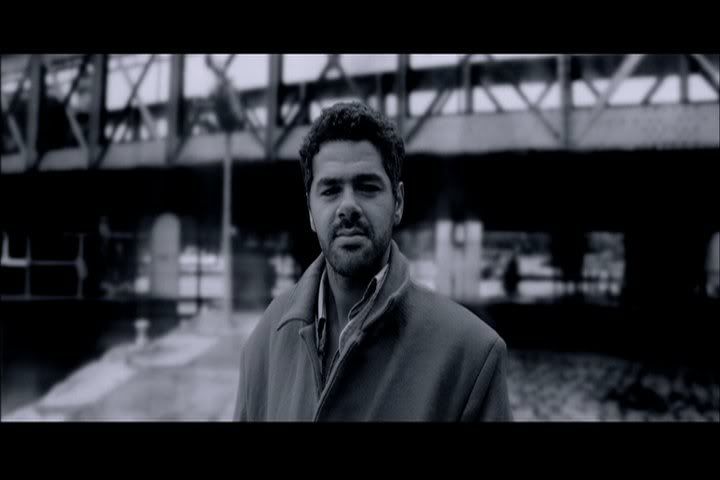
Angel-A is actually a few years old at this point but the American DVD is fairly recent. Released in France right before Christmas in 2005, the film marked the first time Besson had filled a director’s chair since 1999’s highly undervalued The Messenger.
Angel-A is a weird and stylish mix of Frank Capra’s It’s A Wonderful Life, Patrice Leconte’s The Girl On The Bridge and Leos Carax’s Lovers On The Bridge in a slim ninety minute package that contains little of what made those three films so special.
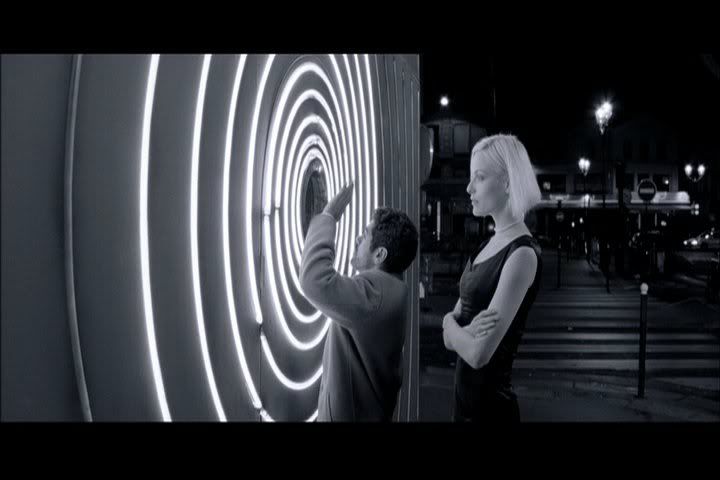
Starring two of modern cinema’s most distinct faces, Jamel Debbouze and Rie Rasmussen and photographed quite well in black and white by award winning Thierry Arbogast, Angel-A feels strangely lethargic and is far removed from the stylistic hyperkinetic triumphs of Besson’s early career. Angel-A feels like the work of a tired man, which it very well may have been as Besson’s role as a producer has been astonishingly prolific in the past decade.
Not only feeling like the work of an exhausted artist, and I do believe Besson is an artist and one of modern cinema’s great stylists, it also has the unfortunate feel of someone not fully engaged with his own material. Certainly the borrowing of scenes and elements from three very distinctive films doesn’t help, but Angel-A just feels under-developed. There are a lot of great ideas here but once you get past how great looking the film is, there just isn’t much left.

Angel-A concerns an ex-con named Andre (played well by the extraordinary Debbouze) who is on the run in Paris as he is in debt to several well known and vicious loan-sharks. While trying to kill himself by jumping off the bridge he is surprised to find a tall and beautiful young woman (Rasmussen) doing the same. After jumping in to save her, she promises to help him in whatever way she can and it soon becomes apparent that the woman hadn’t just fallen from the bridge but literally the sky.
Besson’s film is extremely silly but doesn’t have a lot of humor to it. Wim Wender’s Wings Of Desire and Faraway So Close handled the idea of a guardian angel with so much care and style that it is unfortunate that Besson’s script is so tired and clichéd. The film only works in fits and spells with finally little pay off, with the last scene being one of the most predictable and tired the once exciting Besson has ever delivered.
I really don’t mean to be too hard on Angel-A. As I said there is much to admire. The two lead actors are really fine in their parts and in a couple of scenes, specifically a scene in front of a bathroom mirror, their relationship becomes quite moving.
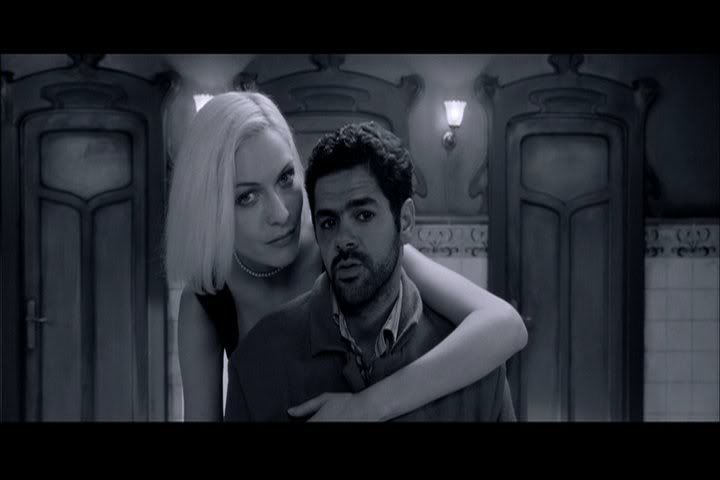
Debbouze, who was so good in Jeunet’s Amelie just a few years before this, has one of the most incredible faces in all of modern cinema and he gives a really nice performance here. Rasmussen, whom I hadn’t seen since her striking turn in DePalma’s Femme Fatale, is even better and she seems to be really relishing the role. A talented and extremely charismatic actor, Rasmussen is currently working on her feature length directorial debut and has also just published a book of her artwork…I see great things for her and she is the best part of Angel-A.
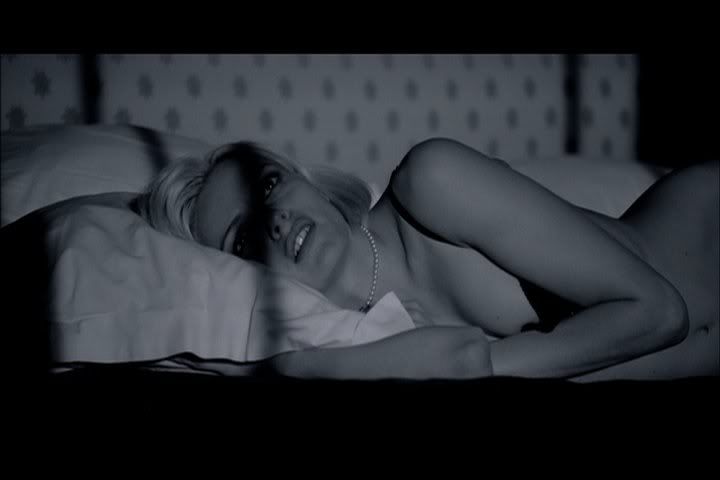
I would finally give Angel-A a slight recommendation if just for its look and leads in the film. It is definitely one of the most disappointing films Besson has ever directed and with his Arthur series apparently obsessing him, it looks like it will be his final non-children’s film for awhile. The American DVD of it contains a fairly sharp transfer, which is flawed by some odd subtitling mistakes and an okay 25 minute documentary. I will revisit the film some day and perhaps my opinion will grow for it, but it will be a while as my first viewing left me down right depressed and more than a little disheartened.

Overlooked Classics: Breathless


We live in a remake crazed world right now where apparently no classic film is safe. I am fully expecting ROSEMARY BABY and EXORCIST remakes to be announced any time now. However it's easy to forget that the cinema world has always been a little remake and recycling crazy. Often the results are horrendous and insulting to the original, TEXAS CHAINSAW MASSACRE, while some play like well meaning tributes, DAWN OF THE DEAD and occasionally some are absolutely inspired, SOLARIS. In the wake of the release of the remake of one of the most legendary horror films, HALLOWEEN, I thought I would pay tribute to an even more audacious remake from almost 25 years ago.
I'm sure critics and film buffs in 1982 were positively flabbergasted when Jim Mcbride announced that he was going to remake Jean-Luc Godard's incredibly influential BREATHLESS. Working with L.M. Kit Carson and Michael Mann, Mcbride began work on his BOUT DE SOUFELL script based on Truffaut and Godard's original probably with the full knowledge of how outraged many of the film community were going to be. For French film fans it was the equivalent of re-making CITIZEN KANE.
Mcbride and Carson made their first collaboration with 1967's fascinating mock documentary, DAVID HOLZMAN'S DIARY. Mcbride would follow that film with the slightly more straightforward MY GIRLFRIEND'S WEDDING in 69. His first narrative feature was the little scene, and rather controversial, GLEN AND RANDA in 1971 which was followed in 1974 by the farcical sexploitation title HOT TIMES.
I don't know a lot about McBride so I can't say how he spent his time between 1974 and 1982. But his early self reflexive documentary work shows him as obviously influenced by Godard and the French New Wave, so there could have been more shocking choices for people to direct a BREATHLESS remake.

The American BREATHLESS stars Richard Gere as the comic book loving, rockabilly obsessed dreamer and small time thief Jesse Lujak. Gere's Lujak is like a dangerous speedball shot of all ego and sex in BREATHLESS. His portrayal is one of the most charismatically narcissistic in American cinema, as the film is filled with shots of him staring into mirrors, dancing by himself, strutting and at times it looks like Gere could literally explode. I love the performance and the remake of BREATHLESS absolutely hinges on it. It's a performance that is probably more difficult to love than hate but there are few that I think to compare it to. Love it or hate it, Richard Gere's Jesse Lujack is undeniably unique.
Gere is of course playing the incredibly iconic Jean Paul Belmondo's role, only McBride had the clever idea of switching him from French to American and then taking the female lead and changing her from American to French. While Godard's stylish film was a French tribute to the low budget American gangster films of the 30's and 40's, Mcbride's remake is a colorful American tribute to the French New Wave.
Filling in for the untouchable Jean Seberg is young French actress Valerie Kaprisky. The lovely Kaprisky took a lot of flack for this role but it's worth mentioning that this was one of her first films and that she barely spoke English. I think she redeems herself quite nicely in the part as the young, naive French student. No less than the great Polish director Andrzej Zulawski was impressed enough to cast her a year later in his sublimely over the top THE PUBLIC WOMAN.

Mcbride's BREATHLESS plays like a compulsive and flashy pop art piece, one that you stare at for awhile trying to figure out whether or not it is actually art or just something hanging on the wall. With it's whirlwind pace, Jack Nitzsche score and stunning splashes of sun stroked Los Angeles color, BREATHLESS is undeniably fun and exciting.
Mcbride's is in powerful command of the medium in this film and his camera rarely sits still, at times it seems like it has had some of the same speed Lujack has been popping but it never feels out of control, or under-prepared. Richard Kline helps give the film it's distinct look and the script is loaded with enough snappy dialogue to make it still feel fresh.

Mcbride's film plays pretty close to Godard's plot wise and ends with the same tragi-comic ending that the original had. Mcbride also crams his film full of references to past films, books and music signalling the remake of BREATHLESS as a clear precursor to 90's cinema and specifically Quentin Tarantino. Tarantino has actually called Mcbride's film a favorite and it is, perhaps much more than most of the films typically mentioned as influencing him, a clear kickoff to Tarantino's reference filled world.
The remake of BREATHLESS polarized most critics upon it's release and was only a minor success at the box office. It signalled the end of part one of Gere's always brave and occasionally inspiring career. He has never been quite this psychotically good again in a role, which isn't discrediting his later work (much of it very fine), but he was became a different actor after Jesse Lujack. Perhaps because Lujack was the obvious end to the particular road he had carved for himself, as an actor, starting with his crazed turn in LOOKING FOR MR. GOODBAR. Where else could Gere go after playing a character literally singing and dancing in the street to celebrate his final moments before getting gunned down?

1983's BREATHLESS makes a lot more sense now than it did 24 years ago. Not at all dated, it now plays as one of the most progressive and seminal films of the 1980s. Unfortunately Mcbride's career since has been frustrating with only the neo-noir , THE BIG EASY, giving hint to his obvious great talents.

One of my favorite postscripts to the remake of BREATHLESS is Luc Besson's 1985 film SUBWAY. Early on we have Besson matching nearly shot for shot a scene, featuring Christopher Lambert stealing a car, from BREATHLESS. This shouldn't have been a surprise as Besson was one of the clear leaders of France's '2nd New Wave' but the shocking thing was that the shot wasn't copied from Godard and Belmondo, but McBride and Gere. It was Besson's sly wink to a sadly underrated and mostly forgotten American film.

The remake of BREATHLESS is currently available on a disappointing full screen dvd from MGM with no extras. The best way to see the film is courtesy of the out of print laserdisc from the mid 90's that had a sharp widescreen presentation and a beautiful sleeve picturing Gere's manic, lost and completely unforgettable loser.

Here are two interesting links. One is to Roger Eberts original negative but at times insightful review and the other is Vincent Canby's original take on it. I think these reviews are interesting in that they show some of the attitudes at the very idea or remaking Godard's film and also for the fact that they almost like it.

http://rogerebert.suntimes.com/apps/pbcs.dll/article?AID=/19830513/REVIEWS/305130301/1023

http://movies2.nytimes.com/mem/movies/review.html?res=9E03EED81138F930A25756C0A965948260

also a link highlighting Tarantino on his favorite films, which include Mcbride's BREATHLESS.

http://www.tarantino.info/index.php?option=com_content&task=view&id=380&Itemid=41

Saturday, June 27, 2026

The Wild Bunch: Cinema du Look 1981-1994


It has been just over twenty five years since Jean-Jacques Beineix's DIVA landed on American shores and alerted audiences that the freshest and most exciting filmmakers were once again coming out of France.
The 'Cinema du Look' movement was an explosion of style, color, fashion, emotion and the three directors most often associated with it produced some of the most recognizable and influential films of the eighties and nineties. The work of Jean-Jacques Beineix, Luc Besson and Leos Carax doesn't get the respect or attention it deserves, at least here in the United States, so here is a small tribute to my favorite films from these three iconic directors, one of which my little blog took its name from.

JEAN-JACQUES BEINEIX:
Born 1946 in Paris.

Key Films:

1. THE MOON IN THE GUTTER (1983): Beineix's most controversial film is the ultimate Cinema du Look film. Stylish, shocking, frustrating and never less than brilliant, Beineix manages to pull in influences ranging from American film noir to the Italian Giallo in the most audacious manner possible. My long look at the film can be found here.

2. BETTY BLUE (1986): The heart of Cinema du Look and the introduction to perhaps is greatest discovery, L'Enfant sauvage Beatrice Dalle.

3. DIVA (1981): The film that kick started the movement remains one of the most visionary and entertaining works of the eighties. Beineix's command of the medium this early on is frankly astounding.

4. ROSELYNE AND THE LIONS (1989): Beineix begins to slip here but it's still a gorgeous underrated production that deserves more recognition.

5. IP5 (1992): An oddly touching but flawed production that teamed Beaineix with French legend Yves Montand.

Works since:
MORTAL TRANSFER (2001)

LUC BESSON:
Born 1959 in Paris

Key Films:

1. LEON (1994): The movement's swan song and one of its greatest achievements. The westernization hinted at in Besson's early productions is near complete here but it strangely only adds to his obvious brilliance and mastery of the medium.

2. SUBWAY (1985): One of the ultimate punk films...silly, moving, bold, sublime and masterful. A simultaneous embracing and rejection of the New Wave Besson grew up with.

3. THE FINAL COMBAT (1983): Besson's feature length debut remains as strange, flawed and as refreshing as ever. This must have felt like a kick in the head to audiences back in the early eighties who had given up on French cinema as a combative force.

4. THE BIG BLUE (1988): Unbelievably beautiful but vacant production that features some of the most unforgettable and strange images of the whole movement.

5. LA FEMME NIKITA (1990): The movement's most overrated production is ironically the easiest to see. Problems aside, the influence of the film cannot be denied but I will always prefer John Badham's underrated remake with Bridget Fonda.

Works Since:
THE FIFTH ELEMENT (1997)
THE MESSENGER (1999)
ANGEL-A (2005)
ARTHUR AND THE INVISIBLES (2006)

LEOS CARAX:
Born 1960 in Paris

KEY WORKS:

1. THE LOVERS ON THE BRIDGE (1991): "Let Paris Rot" indeed. Not just one of the great modern French films but one of the key works of the past few decades.

2. BAD BLOOD (1986): MAUVAIS SANG remains the most Godardian of all the Cinema Du Look's works and it is still a beautiful and imaginative work of art that would mark the team of Carax and Binoche as one of the most remarkable in modern cinema.

3. BOY MEETS GIRL (1984): Compelling and uncompromising first film from the just 23 year old Carax.

Works Since:
POLA X (1999)

I hope to write in detail on all of the above works eventually. French cinema in the eighties of course gave birth to many more great directors (not to mention an incredible number of astonishing performers) but the small body of work by these three men remains a particularly resonate snapshot of a very special time. The relative unavailability of several of the above films shows that they still haven't gotten the due they deserve, at least in America.

Moon in the Gutter (Month By Month)

BLOG CREATED, EDITED and WRITTEN BY JEREMY RICHEY: Began in DEC 2006. The written content of all posts (excepting quotes from reviews, books, other publications) COPYRIGHT JEREMY RICHEY.